
Ketamine
The Dissociative
Drug Spotlight · Dissociative Anesthetic · NMDA Antagonist
TL;DR
Ketamine is a dissociative anesthetic, meaning it doesn’t just put you to sleep the way most anesthetics do. Instead, it disconnects your brain’s sensory processing from your conscious awareness. You’re technically “awake” in some sense, but you’re somewhere else entirely. It works by blocking NMDA receptors, which are the brain’s main excitatory relay stations, and the result is a trance-like state where pain doesn’t register and memories don’t form. What makes ketamine unique in anesthesia is that it largely preserves your ability to breathe on your own and keeps your blood pressure up, two things that most other anesthetics actively suppress. That same pharmacology is why it’s become a battlefield staple, a pediatric go-to, and more recently, a breakthrough treatment for depression. It’s also why it keeps showing up in litigation: its expanding off-label use, especially in ketamine infusion clinics and prehospital settings, has outpaced the guardrails.
Identity
Chemical Profile
Chemical Name
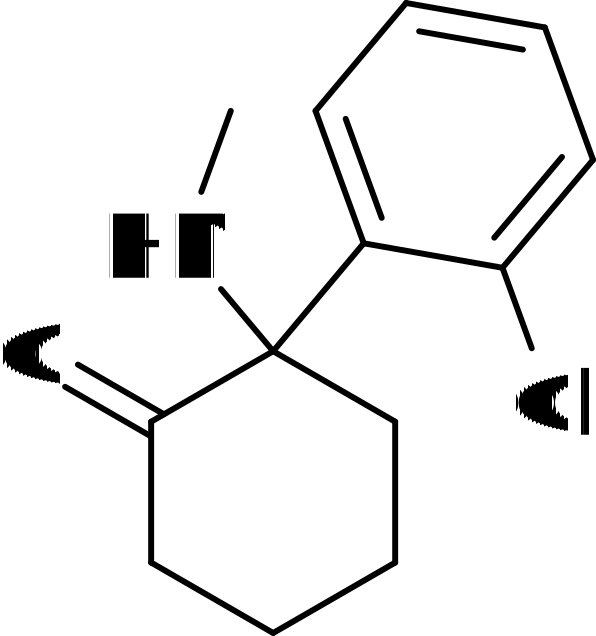
2-(2-chlorophenyl)-2-(methylamino)cyclohexanone
Formulation
Unlike propofol, ketamine is water-soluble, so it doesn’t need a lipid emulsion to stay in solution. It comes as a clear liquid, typically at concentrations of 10 mg/mL, 50 mg/mL, or 100 mg/mL. That concentration range matters, because grabbing the wrong vial is a real source of dosing errors. The drug exists as a racemic mixture of two mirror-image molecules: S(+)-ketamine and R(−)-ketamine. The S-enantiomer is roughly 3–4 times more potent at the NMDA receptor and was eventually developed on its own as esketamine (brand name Spravato), approved as an intranasal spray for treatment-resistant depression. Ketamine can be given IV, IM, intranasally, orally, and even rectally, a versatility that almost no other anesthetic can match.
Key Properties
- Highly lipid-soluble despite being water-soluble in formulation, which allows it to cross the blood-brain barrier rapidly after injection
- Metabolized primarily by the liver (CYP3A4 and CYP2B6) into norketamine, an active metabolite with roughly one-third the potency of the parent drug
- Unlike most IV anesthetics, ketamine stimulates the cardiovascular system rather than depressing it, so heart rate and blood pressure typically rise after administration
- DEA Schedule III controlled substance since 1999, meaning it’s tracked more tightly than propofol but less strictly than opioids
Chemical Structure
Background
History
Ketamine was born out of a search for something better than phencyclidine (PCP). PCP had shown promise as an anesthetic in the 1950s, but it caused prolonged, severe psychotic reactions in patients waking up, which made it far from ideal. Researchers at Parke-Davis wanted the dissociative anesthesia without the nightmare recoveries, and ketamine was the compound that came closest. Its path from lab curiosity to one of the WHO’s essential medicines is one of the more interesting arcs in anesthetic pharmacology.
1962
Calvin Stevens, a consultant chemist at Parke-Davis, first synthesizes CI-581, the compound that would become ketamine. The goal was explicitly to find a PCP analog with shorter duration and fewer psychotomimetic effects.
1964
Corssen and Domino administer ketamine to human volunteers for the first time. Domino’s wife, upon hearing his descriptions of what the subjects experienced, suggests the term “dissociative anesthesia,” a name that sticks permanently. Subjects described feeling disconnected from their bodies and environment while remaining semi-conscious.
1970
The FDA approves ketamine under the brand name Ketalar. Almost immediately, it sees heavy use as a battlefield anesthetic in the Vietnam War. Its ability to be given IM without needing IV access, while preserving breathing and blood pressure, made it ideal for combat medics working under fire with minimal equipment.
1999 – 2000s
After decades of recreational misuse as “Special K” in club scenes, ketamine is classified as a Schedule III controlled substance by the DEA in 1999. Meanwhile, a landmark study by Berman et al. at Yale demonstrates rapid antidepressant effects from a single sub-anesthetic IV dose, a finding that would reshape psychiatry over the next two decades.
2019 – Present
The FDA approves esketamine (Spravato) as an intranasal spray for treatment-resistant depression, marking the first genuinely new mechanism of action in antidepressant therapy in decades. Simultaneously, hundreds of private ketamine infusion clinics open across the US, many operating in a regulatory gray zone that has drawn increasing scrutiny from state medical boards and malpractice attorneys alike.
Pharmacology
How It Works
Most anesthetics work by turning up inhibition. They enhance GABA, the brain’s “quiet down” signal, and everything slows to a stop. Ketamine does something fundamentally different. Instead of amplifying the brakes, it blocks the accelerator. The target is the NMDA receptor, which is one of the brain’s primary excitatory receptors. Normally, the neurotransmitter glutamate binds to NMDA receptors and opens an ion channel that lets calcium rush into the neuron, triggering it to fire. Ketamine physically enters that open channel and plugs it. This is what pharmacologists call “open-channel blockade,” meaning the receptor has to be activated first before ketamine can get inside and shut it down.

The result isn’t unconsciousness in the traditional sense. It’s dissociation. The brain’s ability to integrate sensory input with conscious experience gets disrupted. Patients under ketamine may have their eyes open, may appear to respond to stimuli, and will often breathe on their own, but they are functionally disconnected from pain perception and from forming memories. This is wildly different from what propofol or volatile anesthetics do, and it’s why the term “dissociative anesthesia” was coined specifically for this drug.
Ketamine is highly lipid-soluble and crosses into the brain quickly after IV injection, with onset in roughly 30 to 60 seconds. Like propofol, a single bolus dose wears off through redistribution: the drug moves from the brain into muscle and fat, dropping the brain concentration below the effective threshold within 10–20 minutes. But ketamine’s active metabolite, norketamine, continues to circulate and contribute analgesic effects for much longer. With repeated or prolonged dosing, both ketamine and norketamine accumulate in peripheral tissues, which is why recovery times can stretch out in longer cases.
Dosing at a Glance
IV Induction: ~1–2 mg/kg
IM Induction: ~4–6 mg/kg
Sub-dissociative analgesia: 0.1–0.3 mg/kg IV
IV Onset: ~30–60 sec
IM Onset: ~3–5 min
Duration (single dose): ~10–20 min
Anesthetic Practice
Clinical Application
Ketamine occupies a unique niche: it’s the anesthetic you reach for when the usual options are too dangerous. Its cardiovascular-stimulating, bronchodilating, and airway-preserving properties make it indispensable in specific clinical scenarios where other agents would be harmful.
- Hemodynamically unstable / trauma patients: When a patient is in hemorrhagic shock or sepsis, their blood pressure is already dangerously low. Propofol or barbiturates would drop it further. Ketamine’s to trigger the release of catecholamines like norepinephrine, actually supports blood pressure during induction, buying time until resuscitation catches up.
- Pediatric procedural sedation: Children are notoriously difficult to sedate cooperatively, and starting an IV in a screaming toddler is no one’s idea of a good time. Ketamine can be given IM, which means a quick injection and a calm child within minutes with no IV required. It’s become the standard agent for painful pediatric procedures like fracture reductions and laceration repairs in emergency departments.
- Austere and prehospital environments: In combat zones, disaster scenes, and remote settings where ventilators and monitoring are limited, ketamine’s preservation of spontaneous breathing and airway reflexes makes it the safest available option. A medic can give an IM dose in the field without needing to manage an airway, a luxury no other anesthetic provides.
- Adjunctive analgesia: At sub-dissociative doses (0.1–0.3 mg/kg), ketamine provides meaningful pain relief through NMDA blockade without causing full dissociation. It’s increasingly used as part of multimodal pain regimens in the OR and ICU, particularly to reduce opioid requirements in patients at risk for opioid-related complications.
Body-Wide Effects
- Cardiovascular: Ketamine is the only IV anesthetic that consistently raises blood pressure and heart rate. It does this indirectly by stimulating the sympathetic nervous system and triggering catecholamine release from nerve terminals. This is a feature in hypovolemic patients but a liability in someone with uncontrolled hypertension, aortic dissection, or severe coronary artery disease, where the extra cardiac workload could be dangerous.
- Respiratory: This is ketamine’s superpower. Respiratory drive is largely preserved at dissociative doses, and airway protective reflexes (cough, gag) remain mostly intact, though not perfectly, so aspiration is still possible. Ketamine also relaxes bronchial smooth muscle, making it actively beneficial in patients with reactive airway disease. The one respiratory caveat is that at very high doses or with rapid IV push, transient apnea can occur.
- CNS: Emergence reactions are the main concern, presenting as vivid and often disturbing hallucinations, agitation, and confusion as the drug wears off. These occur in roughly 10–30% of adult patients and are more common in women, with rapid IV administration, and at higher doses. Pre-treatment with a benzodiazepine like midazolam significantly reduces but doesn’t eliminate the risk. Ketamine also increases cerebral blood flow, which historically made it “contraindicated” in raised intracranial pressure, though more recent evidence suggests this concern was overstated, particularly when ventilation is controlled.
- Other effects: Increases salivation, sometimes significantly enough that atropine or glycopyrrolate is given to counteract it. Can cause nausea and vomiting on emergence. Nystagmus (involuntary eye movements) is a characteristic sign that the dissociative state has been reached.
- Contraindications: Poorly controlled hypertension, conditions where a rise in blood pressure could be catastrophic (aortic dissection, intracranial aneurysm), significant psychiatric history where emergence phenomena could be destabilizing, and age under 3 months (limited safety data).
Medicolegal
Litigation Themes
Ketamine cases increasingly involve the drug being used outside the clinical context it was designed for: in infusion clinics, in the back of ambulances, in psychiatric settings with minimal monitoring. The pharmacology hasn’t changed; the use cases have expanded faster than the safety infrastructure around them.
- Off-label infusion clinic complications: The explosion of private ketamine clinics for depression and chronic pain has created a new category of malpractice exposure. Many of these clinics operate without anesthesia providers, without standardized monitoring protocols, and without clear patient selection criteria. When a patient has a cardiovascular event or severe dissociative reaction in a clinic that lacks the personnel or equipment to manage it, the liability question becomes straightforward.
- Prehospital sedation and use of force: The most high-profile ketamine litigation involves its use by EMS to sedate agitated individuals in the field, sometimes at the direction of law enforcement. The 2019 death of Elijah McClain in Aurora, Colorado, after paramedics administered a weight-based ketamine dose to a restrained individual, became a national flashpoint. The core legal questions: Was chemical sedation medically indicated? Was the dose appropriate? Was monitoring adequate after administration? These cases sit at the intersection of medical malpractice, civil rights, and use-of-force law.
- Concentration-based dosing errors: Ketamine comes in three concentrations (10, 50, and 100 mg/mL), and grabbing the wrong vial without recalculating is a well-documented source of 5- to 10-fold overdoses. These cases often involve system-level failures like look-alike vials, absent barcode scanning, and time pressure, rather than individual negligence, but the patient outcome is the same regardless.
- Emergence reactions and inadequate prophylaxis: When a patient wakes up from ketamine thrashing, hallucinating, and in severe psychological distress, and the chart shows no benzodiazepine pre-treatment and no plan for emergence management, the malpractice argument practically writes itself. The standard of care for emergence prophylaxis is well-established, and failure to follow it is difficult to defend.
- Chronic use and urological damage: Long-term or high-frequency ketamine use, whether recreational or in repeated infusion therapy, is associated with a specific and severe form of bladder damage called ketamine-induced cystitis. Patients develop debilitating urinary frequency, pain, and in extreme cases, a non-functional contracted bladder requiring surgical intervention. Litigation has begun targeting infusion clinics that failed to screen for or monitor these effects over extended treatment courses.
Best Practice
Ketamine’s pharmacology is its own best argument for disciplined use. The same NMDA antagonism that preserves hemodynamics and breathing also produces emergence phenomena, sympathetic stimulation, and a dissociative state that can be mistaken for adequate anesthesia when the patient is actually distressed. Every advantage has a corresponding risk that demands anticipation. Benzodiazepine co-administration for emergence prophylaxis, concentration verification before every dose, continuous monitoring in any setting (clinical or off-label), and honest patient selection that accounts for cardiovascular and psychiatric risk factors aren’t optional add-ons. They’re the minimum standard. When ketamine cases go to litigation, the question is almost never whether the drug was a reasonable choice. It’s whether the provider built the safety infrastructure around it that the pharmacology demands.
References
- Zanos P, Moaddel R, Morris PJ, et al. Ketamine and ketamine metabolite pharmacology: insights into therapeutic mechanisms. Pharmacol Rev. 2018;70(3):621–660. PMC6020109
- Domino EF. Taming the ketamine tiger. Anesthesiology. 2010;113(3):678–684. PMID: 20693870
- Green SM, Roback MG, Kennedy RM, Krauss B. Clinical practice guideline for emergency department ketamine dissociative sedation: 2011 update. Ann Emerg Med. 2011;57(5):449–461. PMID: 21256625
- Berman RM, Cappiello A, Anand A, et al. Antidepressant effects of ketamine in depressed patients. Biol Psychiatry. 2000;47(4):351–354. PMID: 10686270
- Gorlin AW, Rosenfeld DM, Ramakrishna H. Intravenous sub-anesthetic ketamine for perioperative analgesia. J Anaesthesiol Clin Pharmacol. 2016;32(2):160–167. PMC4874066