
Fick Principle
Arteriovenous Extraction, Cardiac Output, and the Shift from Direct to Indirect Measurement
Cardiovascular Physiology · Capnography · Case Analysis
Background:
Fick Principle: the physiological rule stating that the total uptake or release of a substance by the peripheral tissues is equal to the product of the blood flow to the peripheral tissues and the arterial-venous concentration difference of the substance. It is most commonly used to calculate cardiac output.
When thinking through how blood moves and delivers nutrients, this principle breaks down into a simple equation of supply and demand. If we know how much oxygen the body is consuming and we measure how much oxygen is dropped off in the tissues, we can calculate exactly how fast the blood must be circulating to keep up.
- Direct Fick Method: this is the classic approach where a patient breathes continuously from a spirometer to precisely measure oxygen consumption, paired with invasive arterial and mixed venous blood samples to measure oxygen extraction.
- Indirect Fick Method: this relies on estimated values for oxygen consumption based on body surface area rather than measuring it directly, making it much more practical for intensive care units.
This concept was first described by Adolf Eugen Fick in 1870, and it remains the gold standard theoretical framework for understanding systemic blood flow.
The Oxygen Budget:
To really understand the arteriovenous oxygen difference, we have to look at it like a financial budget. The arterial blood leaving the left side of the heart is the gross income, fully loaded with oxygen. As this blood travels through the capillary beds, the organs consume their required share. The venous blood returning to the right side of the heart is whatever savings are left over. If the tissues suddenly need more oxygen but the heart cannot pump blood any faster, the tissues will simply extract a larger percentage of oxygen from the blood that is available. This widens the gap between the arterial supply and the venous return.
The standardized oxygen budget of a healthy resting adult can be broken down into these concrete values:
- Arterial oxygen content: roughly 20 milliliters of oxygen per 100 milliliters of blood
- Mixed venous oxygen content: roughly 15 milliliters of oxygen per 100 milliliters of blood
- Arteriovenous oxygen difference: the resulting 5 milliliters of oxygen extracted per 100 milliliters of blood
- Total oxygen consumption: approximately 250 milliliters of oxygen per minute
From this comparison we can see that the body normally extracts only about 25 percent of the oxygen delivered to it, leaving a massive reserve capacity for times of high metabolic stress.
Measurement Modalities:
Calculating cardiac output is not a one size fits all procedure, and clinical teams choose from several distinct monitoring modalities based on patient acuity and resource availability.
- Direct Fick (highly precise, requires steady state): Uses continuous exhaled gas analysis to calculate exact metabolic consumption.
- Indirect Fick (assumed consumption of 125 milliliters per minute per square meter): Uses a nomogram chart to guess resting metabolic rate instead of measuring it, saving time but losing accuracy.
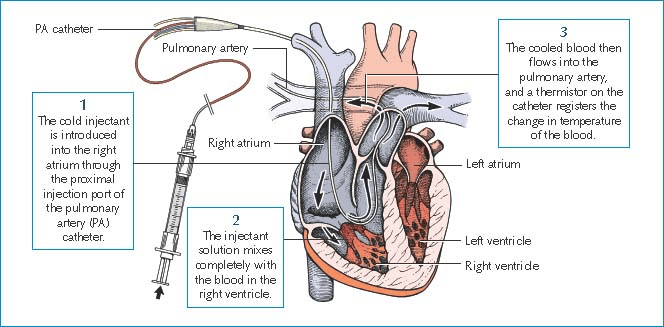
- Thermodilution (requires a pulmonary artery catheter): Injects a known volume of cold saline into the right atrium and measures how long it takes for the temperature to change in the pulmonary artery.
- Continuous Cardiac Output (updated every 3 to 6 minutes): Uses a specialized thermal filament on the catheter that constantly pulses small amounts of heat into the blood.
The transition from the classic Fick principle to thermodilution makes perfect sense when you look at the architecture of the critical care environment. Measuring exact oxygen consumption via exhaled gas requires bulky metabolic carts and a perfectly cooperative patient who is not breathing any supplemental room air. By shifting the measurement indicator from oxygen molecules to thermal energy, clinicians can bypass the lungs entirely. The right heart becomes a mixing chamber where cold fluid is diluted by warm blood, and the resulting temperature curve mathematically mirrors the exact same dilution principles that Fick originally outlined for oxygen.
In Practice:
The Fick equation is entirely dependent on the assumption that a patient is in a steady state, but human physiology in the operating room is incredibly dynamic.
Temperature is the most aggressive modifier of the metabolic rate. For every 1 degree Celsius drop in core body temperature, cellular oxygen consumption decreases by approximately 7 to 9 percent. Because the indirect Fick method assumes a standard metabolic rate based solely on height and weight, applying it to an accidentally hypothermic surgical patient will massively overestimate their true oxygen consumption. If the assumed numerator is falsely high, the resulting cardiac output calculation will be falsely elevated, masking true low flow states.
Shivering actively destroys the steady state requirement. A patient waking up cold can increase their oxygen consumption by up to 400 percent as their muscles rapidly contract to generate heat, making venous oxygen levels plummet unpredictably.
Anesthesia induction uniformly depresses the metabolic rate. When a patient receives a standard dose of an induction agent, their whole body oxygen demand reliably drops by roughly 20 to 30 percent as consciousness is ablated and muscular tone relaxes.
Other factors that wreck the assumed oxygen consumption values include severe agitation (↑), the administration of paralytics (↓), profound hyperthyroidism (↑), and systemic inflammatory response syndrome (↑).
Limitations
It is vital to recognize where the indirect Fick method falls apart. Because it leans on estimated metabolic values, it consistently introduces a 10 to 15 percent error margin even in stable, healthy patients. In critically ill patients with sepsis or major trauma, this error margin can exceed 30 percent, rendering the calculation dangerously misleading.
Thermodilution is not immune to structural breakdown either. If a patient has severe tricuspid valve regurgitation, the cold saline gets pushed backward into the right atrium with every heartbeat instead of flowing smoothly forward. This delayed transit artificially flattens the temperature curve, which the computer misinterprets as a falsely low cardiac output.
Clinicians managing these complex patients often cross reference Fick calculations with continuous capnography trends, because a sudden drop in exhaled carbon dioxide frequently points to an abrupt decline in pulmonary blood flow.
In practice, calculated cardiac output is best understood as a baseline calibration point for trending patient trajectory, rather than an absolute truth to blindly medicate.